The War of 1812 in Miami County

During the War of 1812, Upper Piqua continued to be under the flag of Anthony Wayne.
Historians often overlook the role of men that lived on the frontier borders during the War if 1812; focusing on better documented scenarios. Miami County was formed in 1807, and was only five years old when the War of 1812 began.
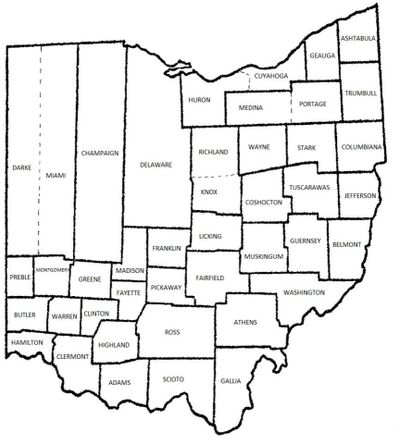
State law required that all men from ages 18-45 serve in the Militia. The Miami Militia had been functional since 1809 and belonged to the First Division of the Ohio Militia. In 1813, Miami became part of the Fifth Division, along with Greene, Montgomery, Champaign, Preble, and Darke Counties.

At the declaration of war, General Harrison, commander of the Federal troops in the northwest, issued a local call to arms. Many men who already were in local county Militias volunteered to serve with Harrison. Preble, Greene and Miami counties were exempt from war draft because they were considered war zones. Other men from these counties that did not volunteer to serve with Harrison formed volunteer Militia companies.
The Miami County Militia's uniforms consisted of the following:
light blue hunting frocks
a leather belt with an ax and knife tucked in
a shot pouch
a powder horn
a rifle
Most men already had all of these items. (Dyeing the hunting frock a common color for Militia duty was a standard practice throughout the United States.) Ohio Militia records indicate the first Miami companies were riflemen. Records also confirm a shortages of supplies. Since Miami’s men were already at the edge of civilization, supply shortages meant a bit less to them.

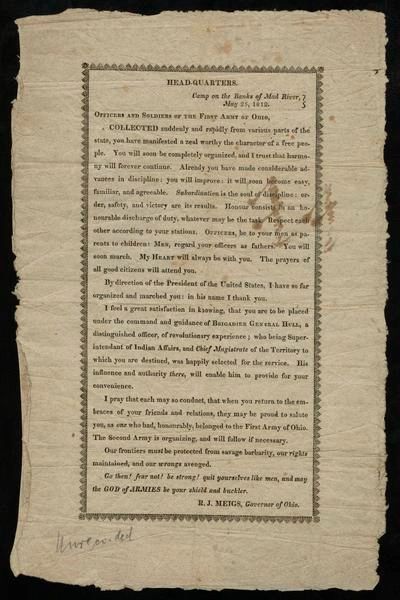
In early April, 1812, President Madison issued instructions to Governor Return Jonathan Meigs of Ohio to assemble the Militia at Dayton, Ohio.
The troops drilled and prepared to march to Detroit. President Madison commissioned William Hull, Governor of the Michigan Territory, as Brigadier General of the Northwest Territory Army. He was to lead the Army of Ohio. This army consisted of 600 regular troops, and 1,600 state Militia troops.
General Hull (who was Ohio Governor Meigs brother- in-law) arrived in Dayton, Ohio on May 25th, 1812. He left with his troops on June 1st, to march on Detroit as ordered by President Madison. General Hull was 58 years old at the time of his appointment. He was not in good health, and had lived a life of excess eating and drinking. He also had stroke in 1811. It affected his ability to think clearly. Like many regular army officers, he viewed the Militia as untrained and untrustworthy. Consequently he treated them with little respect.
Eventually, he and over 2,000 men made their way through the state and across the border in to the Michigan Territory. After an encounter with General Brock, Hull surrendered unconditionally to the British. Hull's primary reasons for surrendering 2,000 men to 700 British and Canadian soldiers were:
1. His concern that a massacre would include the many women, children (including his own daughter, and grandchildren) and older people who were with him.
2. His mental health. He was unable to speak clearly, and demonstrated disorganized thinking.
3. Lack of support from several state Militia units who had refused to cross state lines.
In total, Hull and the Northwest Territory Army surrendered Fort Detroit and all its contents, 600 regular army, 1,600 Militia, 2,500 muskets, 30 pieces of heavy artillery, and 50 barrels of gunpowder. He also surrendered many boats, a baggage train of 100 pack animals, and provisions for 20 days.
In autumn of 1811, John Mann and Alexander Ewing had scouted for Harrison near Prophetstown, Indiana. Sometime after their return to Ohio, both are promoted to the rank of Colonel by Governor Meigs for “acts of valor”. In early 1812, John Mann was elected as Colonel over the Miami County Militia. At that time, county militia hierarchies were determined by popular vote within each count militia.
At the outset of the war, Colonel Mann established several independent rifle companies to patrol the frontier. Fortifications are established or re-established at Covington, Fort Loramie, Greenville, Piqua, Sidney, St. Marys, and Staunton.
The locations of these structures were previously areas used by General Anthony Wayne with the exception Fort Mann in Sidney, and the Fort at Staunton. Staunton was Miami County's seat at this time, and Fort Mann in Sidney was on or near a trail following the Miami River that led to Colonel Johnston's headquarters at Upper Piqua.
In 1813, the Miami County Militia became part of the 5th Division of the Ohio Militia. Area Indian attacks during the war included men being killed at St. Marys, Urbana, Springfield, and Greenville. Two young girls were killed while traveling one half mile from Greenville, and two men traveling from Greenville to Preble County were also murdered. Indians then attacked settlers in Miami County.
The double murder of Mr. and Mrs. Dilbone occurred east of Piqua was followed by the murder of David Gerard that occurred on Spring Creek.
Later, toward the close of the war, Jane Williamson Carey, wife of Cephas Carey who lived in Hardin, Ohio, was killed when several Shawnee attacked the Carey Blockhouse on their farm (August 1814). Cephas was the blockhouse adjutant, having built the blockhouse for his family and other early Shelby County area settlers to take shelter.
All throughout the war, Miami County’s men continued to run a line of defense from Urbana to St. Mary's, and discouraged invasion on the western border of the state. They patrolled the areas, were stationed at blockhouses, and moved to and from Staunton, Piqua, Sidney, Covington, Greenville, Fort Loramie, St. Marys, Urbana, and Wapakoneta.
Governor Meigs was on the frontier and ordered Miami’s men to perform widespread duties, including staffing detachments. Men that did not patrol manned local blockhouses.
Immediately following General Hull's surrender, Harrison marched north in his famous campaign toward the Indian Territories. He and his favored Kentucky Militia came through Miami County. He used these men because he had prior battle experience with them. It is also important to remember that Kentucky had more established settlement. 30 years on the frontier provided a more established, organized, and disciplined army.
His friend and ally, Colonel John Johnston, a Federal Indian Agent located in the northern part of the county, also found the Miami Militia uncooperative. Although Johnston was representing the Federal government, he was not part of the Ohio Militia leadership hierarchy, and consequently the Militia did not always answer his requests.

The citizens Miami and Darke County citizens had more to fear than people in eastern counties of Ohio. They readily received the Kentuckians' assistance. The Kentuckians did get the glory and recognition. Ohio's soldiers felt it shamed them almost as much as Hull's surrender did. In early Miami County, here were many family ties to the Kentuckians. This was the frontier and locals were frontiersmen. They found favor among the Kentuckians. The Kentuckians and Miami County men together rebuilt Fort Greenville.
Within the Miami County Militia, there was a military element in men such as Alexander Ewing and John Mann, both Colonels in the Ohio Militia hierarchy and were at times federalized, as were Major Jacob Mann and Captain John Williams, who led groups of sharpshooters or performed duties as spies or scouts on the frontier. The Miami Militia was involved in many tasks not recorded by local history books. Many men from Miami and Darke Counties were periodically federalized and there is little or no information showing their federal duties in Ohio Militia records. NARA records show that Miami's men participated in events such in the Relief of Fort Wayne, the Siege of Fort Meigs, as Dragoons, or as Tupper's Advanced Guard during the sweep across the Maumee Basin.
It is not just ranking officers that deserve credit for service. Many companies of local men were assigned to locally, and at times, deployed throughout the state. Miami's men were active at Johnston's Fort at Upper Piqua, and at times, were deployed along side Federal and Kentucky Troops. The size and scope of Johnston's fort are seldom recognized.
Historians ignore this site because the history is buried. Fort Johnston often served as Harrison's frontier headquarters during the first year of war..... and it was 10 acres in size.... equal to the size of Fort Meigs. Other than Fort Greenville, Fort Meigs and Johnston's Fort were the two biggest forts in Ohio. Johnston became a Colonel at this time, serving on Harrison's staff as a Federal Paymaster and Quartermaster.
The Miami Militia stepped up at a critical time …. in the midst of food shortages, clothing shortages, and Indian hostilities…. to provide security and defense for the state of Ohio.